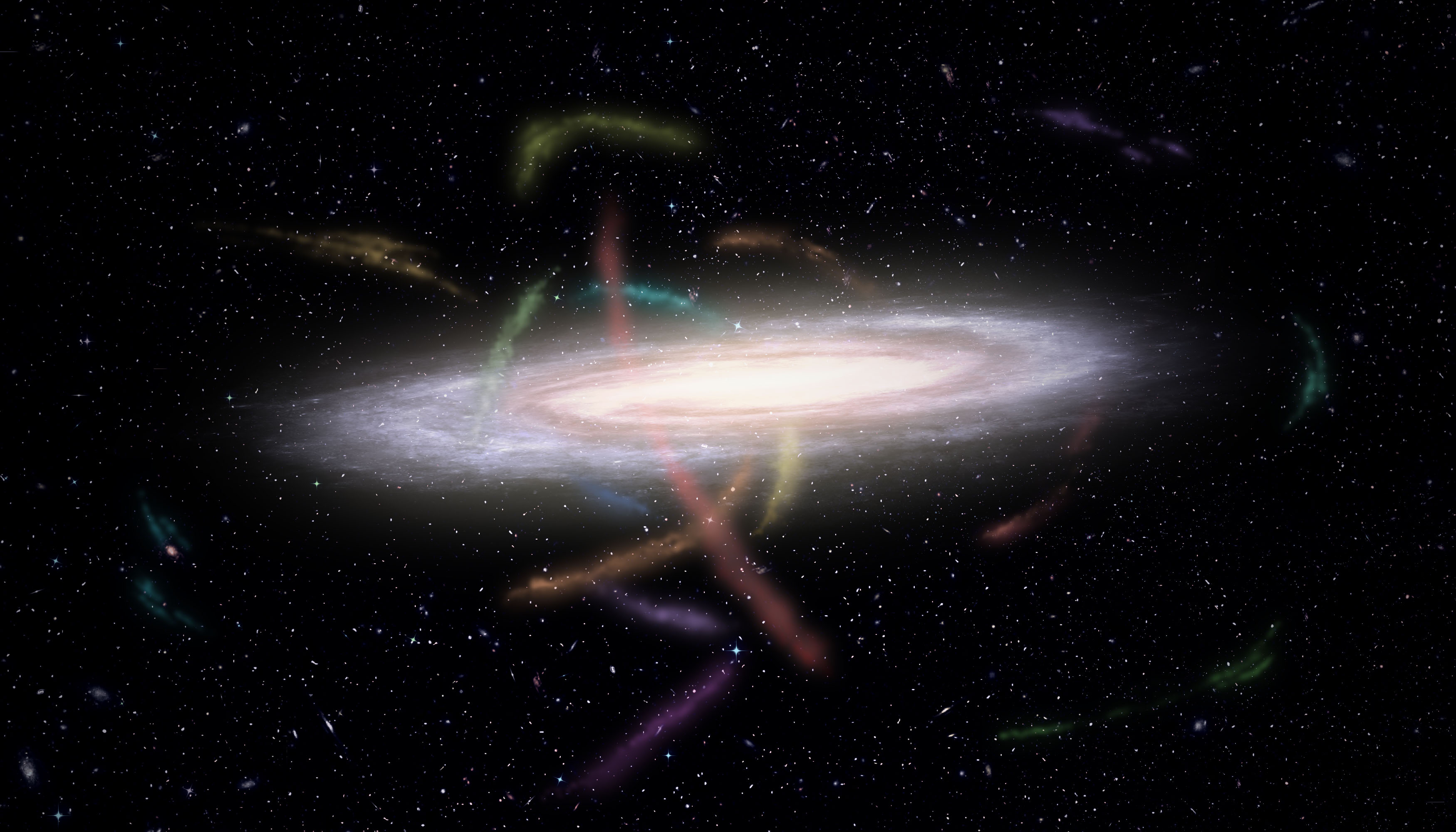
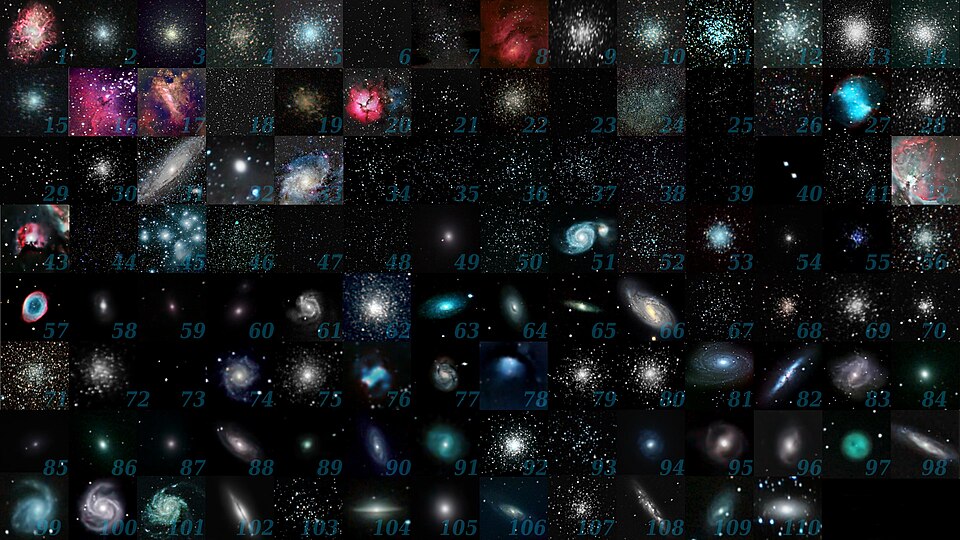
This thesis investigates stellar streams originating from globular clusters (GCs) in the Milky Way. Stellar streams are long, thin structures composed of stars that have escaped their host stellar system, forming coherent tails that can span large regions of the sky (Fig. 1). Globular clusters were first systematically cataloged by Charles Messier in the late 1700s – not for their scientific interest at the time, but to help comet hunters avoid mistaking these nebula-like objects for new comets (Messier 1781). Many of the most prominent globular clusters, along with diffuse nebulae and external galaxies, are included in the Messier catalog (Fig. 2). Physically, globular clusters are dense, gravitationally bound systems containing hundreds of thousands to millions of stars, and are an important source of stellar streams.
In Chapter 4, I present our study in which we simulated the expected distribution of stellar streams originating from the entire Milky Way globular cluster system. This study was the first of its kind. Stellar streams have high hopes for being inferential tools for fine details of the gravitational field of the Milky Way, notably for constraining the presence of dark matter subhalos. These halos may perturb the stellar streams leaving “gaps” in their wake. Since structure of stellar streams are sensitive to local and global gravitational field, all phenomena that can influence the streams must be well calibrated to ensure proper inference of the distribution of dark matter within the Milky Way. In Chapter 5, we explored how the collective gravitational influence of all globular clusters can perturb streams to produce such gaps.
The structure of the thesis is as follows. The remainder of the introduction provides background on stellar streams, globular clusters, and their astrophysical context, as well as an overview of the current state of the field. Chapter 2 outlines the physical framework used to model stream formation and interpret their morphology. Chapter 3 describes the numerical methods employed in the simulations, including convergence tests and estimates of computational cost. Chapters 4 and 5 present two published studies (S. Ferrone et al. 2023; Salvatore Ferrone et al. 2025), with the final chapter discussing these results in the broader context of the literature and highlighting future directions. The appendices presents additional studies I have contributed to during this thesis, concerning either the study of stellar streams or the population of asteroids in the solar system – another field of research that I have explored over the years.
Before explaining why Milky Way globular clusters and stellar streams are scientifically interesting, it is important to first set the scene. This thesis fits neatly within the field of galactic astronomy, which, at its core, studies the current state of our galaxy and the processes that shaped its formation within the broader context of the Universe.
If we start this narrative from the beginning and place stellar streams and globular clusters in the timeline of cosmic history, their importance becomes clear. The story begins best at the very start. The Lambda Cold Dark Matter (\(\Lambda\)CDM) cosmological model is currently the leading theory of the Universe, successfully unifying a variety of observational evidence from the Cosmic Microwave Background Radiation and the large-scale distribution of galaxies to the accelerating expansion of the Universe, etc. (Carroll 2001; Perivolaropoulos and Skara 2022).
Shortly after the Big Bang, conditions allowed protons, neutrons, and electrons to form and interact. For a few minutes, these particles collided and fused into heavier elements in a process known as Big Bang Nucleosynthesis (Steigman 2007). When this phase ended, the Universe’s composition was mostly hydrogen, deuterium (\(^2\)H), helium-4 (\(^4\)He), and trace amounts of helium-3 (\(^3\)He) and lithium-7 (\(^7\)Li). By mass, hydrogen made up roughly 75%, and helium about 25% of the primordial Universe (Peebles 1966; Cyburt et al. 2016).
\(\Lambda\)CDM posits the existence of dark matter and that it has about five times more mass than ordinary matter (Planck Collaboration et al. 2020). Dark matter plays a critical role in galaxy formation. In the early Universe, dark matter was distributed nearly uniformly. Over dense regions caused it to collapse into a cosmic web of filaments and nodes. These massive nodes created deep gravitational wells that attracted ordinary matter (Press and Schechter 1974). The infilling gas subsequently cooled and formed stars. The resulting complex of stars, gas, and dark matter constitutes a galaxy (Plionis, López-Cruz, and Hughes 2008; Mo, van den Bosch, and White 2010).
Galaxies contain stars that are born, fuse hydrogen and helium into heavier elements, and eventually die, at times as supernovae, enriching the interstellar medium with these heavier elements (Maiolino and Mannucci 2019). The stellar formation process is a strong function of cosmic time as the chemical evolution of the Universe becomes more metal rich. For example, the first generation of stars, known as Population III (Pop III) stars2 are thought to have formed in a very different environment, one devoid of metals (Abel, Bryan, and Norman 2002; Glover 2005; Bromm 2013).
The chemical composition of the gas is crucial since it influences the initial mass function (IMF) of stars. Stars formed from pristine, metal-free gas tend to have a top-heavy IMF, favoring the formation of massive stars (R. Schneider et al. 2002; Raffaella Schneider et al. 2006). In contrast, even small amounts of metals introduced into the gas can dramatically shift the IMF toward favoring the formation of lighter stars (Chon, Omukai, and Schneider 2021).
Globular clusters are, to first approximation, single-stellar populations: their constituent stars formed from the same molecular cloud over a timescale shorter than the internal dynamical time (Aarseth, Lin, and Papaloizou 1988; Fellhauer, Wilkinson, and Kroupa 2009; Krumholz 2014). Owing to their uniform chemical composition, stellar evolution within a cluster proceeds along the color-magnitude diagram as a function solely of initial mass (Kippenhahn, Weigert, and Weiss 2013). This property enables precise age determinations from photometric observations, a method that historically provided the first robust lower limits on the age of the Universe (Hoyle 1959; Sandage 1970; R. G. Gratton 1985; Murray and Lin 1992). With their low metallicities and advanced ages, globular clusters are dominated by Population II stars, indicating that they formed in environments enriched exclusively by the earliest generations of stars (Corazza, Miranda, and Wuensche 2022). They thus constitute valuable fossil records of the initial phases of star formation and chemical evolution in the Universe.
Globular clusters are among the most ubiquitous stellar systems in the Universe (Brodie and Strader 2006; Krumholz, McKee, and Bland-Hawthorn 2019). They are found in virtually all galaxy types, from dwarfs to giant ellipticals, and their total number correlates with global properties of their host galaxies such as mass and luminosity (e.g., Harris, Harris, and Alessi 2013; Forbes et al. 2018). In the local Universe, we can directly observe the formation of massive bound stellar systems – so-called young massive star clusters – which may represent present-day analogs of the GC formation process (e.g., Portegies Zwart, McMillan, and Gieles 2010; Adamo et al. 2020), though whether all such systems will evolve into globular clusters remains an open question.
Globular clusters serve as unique astrophysical laboratories, offering insights into stellar dynamics, stellar evolution, and galaxy assembly. Their evolution involves stellar structure and evolution, gravitational dynamics, and relativistic effects in dense environments. For instance, close stellar encounters and binary interactions – such as mass transfer or mergers – are common in such environments and significantly shape cluster evolution (Davies, Piotto, and de Angeli 2004; Wang et al. 2016; Arca Sedda et al. 2024). Additionally, globular clusters are suspected to be a pathway for forming intermediate-mass black holes (IMBHs) (Breen and Heggie 2013; Giersz et al. 2015). The origin of IMBHs remains uncertain, as their masses are too large to be explained by isolated stellar evolution, yet too small to fall into the supermassive category (Greene, Strader, and Ho 2020).
Moreover, while traditionally considered as single stellar populations that are homogeneous in age and chemical composition, decades of spectroscopic and photometric evidence have revealed the presence of multiple stellar populations in most GCs (D’Ercole et al. 2008; Conroy and Spergel 2011; Raffaele G. Gratton, Carretta, and Bragaglia 2012; Bastian and Lardo 2018). The origin of these multiple populations remains debated, with proposed explanations ranging from self-enrichment to accretion of external material, but no consensus has yet emerged.
A striking property of many GC systems is the bimodality in their metallicity distribution, with one population of metal-poor GCs and another of metal-rich GCs (e.g., Brodie and Strader 2006; Harris, Harris, and Hudson 2015). This bimodality is now widely interpreted as evidence for multiple formation channels: metal-rich GCs likely formed in situ within the main progenitor galaxy during intense star-formation episodes, whereas metal-poor GCs were predominantly accreted from lower-mass satellites. The persistence of this bimodality across a wide range of galaxies suggests that hierarchical accretion has been a fundamental process shaping GC systems, and thus galaxies themselves.
Indeed, from the perspective of galaxy formation, the hierarchical model of structure growth posits that galaxies assemble through repeated mergers and accretion of smaller systems (Somerville and Davé 2015). In this framework, GCs can form in situ within the main progenitor or be accreted from satellite galaxies (e.g., Forbes and Remus 2018; Kruijssen et al. 2020; Malhan et al. 2021; Malhan 2022; Pagnini et al. 2023, 2025; Belokurov and Kravtsov 2024). Consequently, the spatial distribution, kinematics, chemical abundances, and metallicity substructure of a galaxy’s GC system retain valuable information about its merger history and assembly pathways. This makes GCs not only tracers of early star formation, but also fossil records of the build-up of their host galaxies.
In essence, globular clusters are involved in many astrophysical processes such as the hierarchical formation of galaxies, formation of intermediate black holes, and being products of barely enriched gas in the early states of the Universe (Kimm et al. 2016; Kruijssen 2025). Fully understanding their formation and evolution ties neatly into a variety of astrophysical problems.
Globular clusters are of considerable astrophysical interest – not only for studies of stellar formation and evolution, rich internal dynamics, black hole formation, and their role in the build-up of galaxies – but also because they are prolific progenitors of stellar streams. As we will show in the next chapter, tidal forces excite stars within the clusters to eventually escape with small speeds that keep the ejected material along more or less the same trajectory, creating the stellar streams.
These streams are particularly valuable astrophysical tools. Their discovery and theoretical explanation date back to the 1990s (see the introductions to Chapters 4 and 5, after which both observational and theoretical work accelerated rapidly. For example, R. A. Ibata et al. (2002) proposed that stellar streams could be sensitive probes of the dark matter subhalo population (see Chapter 5 for a more detailed discussion).
Because stellar streams trace extended, coherent arcs across the sky, they serve as natural guides for mapping the Galactic gravitational field. Koposov, Rix, and Hogg (2010) used the GD-1 stream to constrain the Milky Way potential, while Varghese, Ibata, and Lewis (2011) performed numerical experiments demonstrating that streams can constrain their host potential even with incomplete phase-space information (e.g., sky positions alone, positions plus radial velocities, or positions plus distances). Bovy et al. (2016) also applied this approach to the Palomar 5 and GD-1 streams, and Law and Majewski (2010) investigated the shape of the Galactic dark matter halo using the Sagittarius stream.
These pioneering studies demonstrated the potential of stellar streams as astrophysical probes, but they represented only the beginning. With the advent of the Gaia mission (Perryman et al. 2001), the volume and precision of available data have transformed what is possible.
The current era of Galactic astronomy is undoubtedly defined by the Gaia space mission (Gaia Collaboration, Prusti, et al. 2016; Gaia Collaboration, Brown, et al. 2016; Gaia Collaboration et al. 2018, 2021, 2023). The European Space Agency’s space-based observatory conducted continuous observations of the sky to perform precise astrometric measurements. Operating since 2014, Gaia improves its data volume and quality each year through repeated parallax measurements. As of Data Release 3, the mission has provided distances and proper motions for nearly two billion stars in the Galaxy, along with more than thirty-three million of radial velocity measurements (Gaia Collaboration et al. 2023). This yields five-dimensional phase-space information (positions and on-sky velocities) for about 1-2% of the Galactic stellar population. Although the radial velocities are limited to relatively bright stars, the resulting dataset is still unprecedented in scope.
When additional measurements are required, Gaia data are often complemented with observations from other facilities. For example, Gaia struggles to determine parallaxes in the crowded interiors of globular clusters, where high stellar densities pose challenges for its instruments (Pancino et al. 2017). To address this, Baumgardt and Vasiliev (2021) combined Gaia EDR3 astrometry with Hubble Space Telescope observations, enabling precise distance measurements for 162 globular clusters.
Several ground-based spectroscopic surveys aid in extending Gaia’s radial velocity measurements to fainter magnitudes and in providing detailed chemical abundances. Examples include the Apache Point Observatory Galactic Evolution Experiment (APOGEE; (Majewski et al. 2017)), the Gaia-ESO Survey (Gilmore et al. 2022), GALAH (Zucker et al. 2012) and upcoming wide-field facilities such as 4MOST (de Jong et al. 2019) and WEAVE (Dalton et al. 2014).
These large data sets have led to a rapidly increasing number of
stellar stream discoveries. With the advent of the
streamfinder algorithm (Malhan and Ibata
2018; Malhan et al. 2018), many streams could be detected
simultaneously. This was possible because streamfinder
agnostically applies a friend-finding algorithm to identify coherent
stellar groups in the data. It was initially applied to a small number
of streams to reassess their properties and discuss their
characteristics in light of the improved quality and quantity of the
data (Rodrigo A. Ibata
et al. 2019; R. Ibata et al. 2020).Encouraged by these initial
successes, the method was scaled up to the full Gaia dataset, allowing
for a systematic search across a much larger region of the sky. R. Ibata et al.
(2021) subsequently applied streamfinder to Gaia DR2
and EDR3, resulting in a major increase in the number of known stellar
streams. This analysis improved the data quality for many previously
known streams and led to several new detections, a selection of which is
reproduced in Fig. 3.
They reported nine new streams, bringing the total number of known
Galactic stellar streams to about sixty.
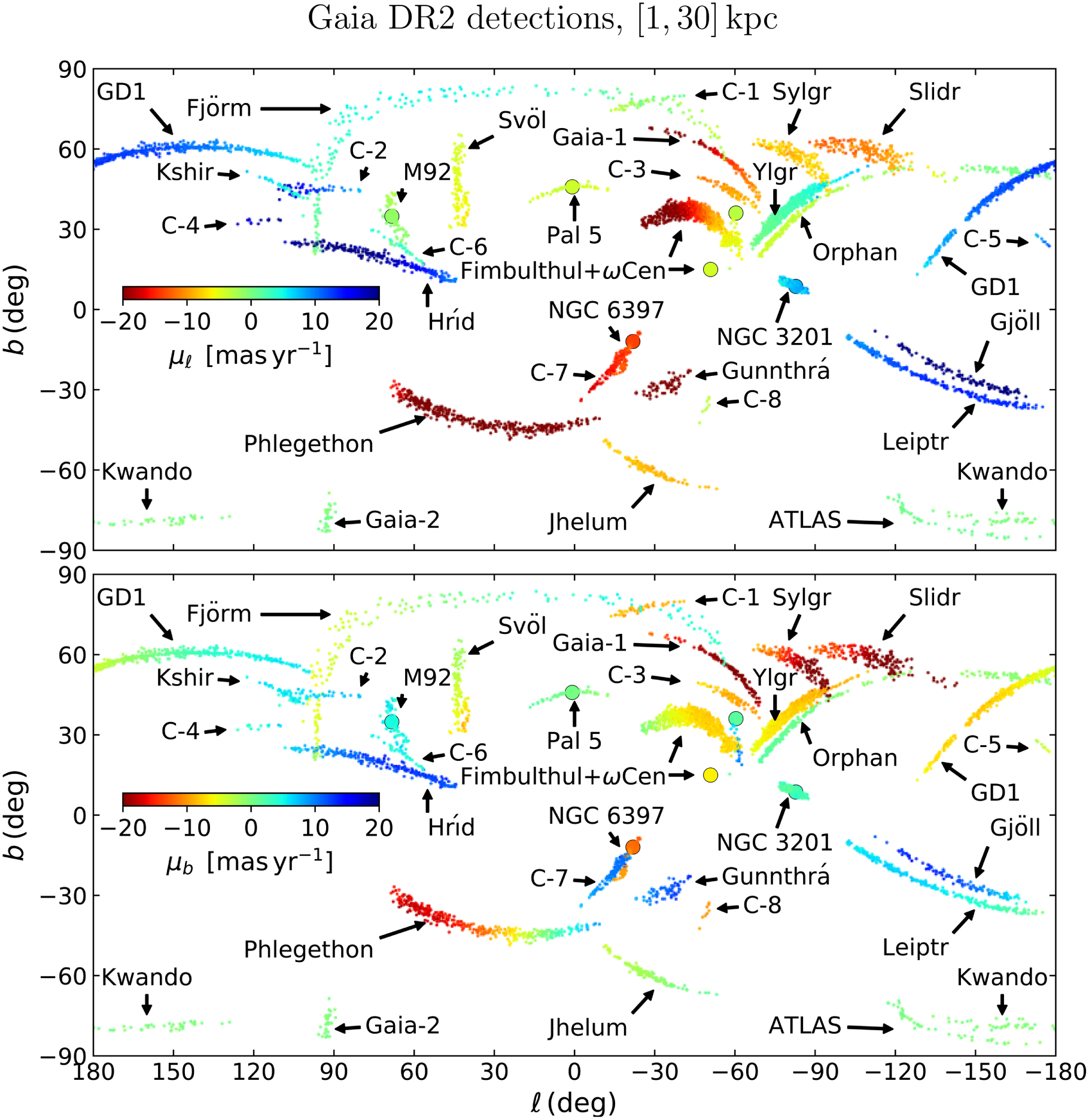
streamfinder in Gaia DR2. Both plots are shown in Galactic
coordinates. The top panel is color-coded by proper motion in longitude,
while the bottom is color-coded by proper motion in latitude. This is
Fig. 1 from R.
Ibata et al. (2021).The work of R. Ibata et al. (2021) was a primary motivation for this study. They showed that, of the roughly sixty stellar streams known at the time, only twenty were associated with globular clusters. As summarized in Piatti and Carballo-Bello (2020), no clear correlations have been found between a cluster’s orbital or structural parameters and the presence (or absence) of tidal tails. This motivated our simulation of the expected mass-loss distribution for the entire Milky Way globular cluster population, presented in Chapter 4.
The improved quality and completeness of stellar stream catalogs in the Gaia era have rapidly expanded the scope of scientific applications. With these data, many studies have already begun to address a wide range of questions, including:
reconstructing the accretion history of the Milky Way;
measuring the local and global gravitational potential;
probing the influence of time-dependent dynamical processes such as the bar, giant molecular clouds, and dark matter subhalos.
A recent review by Bonaca and Price-Whelan (2025) provides a comprehensive overview of some of these efforts. Usefully, they classify stream morphology as the result of three main factors: (1) the internal dynamics of the progenitor system, which determine the rate and energy of escaping stars; (2) the smooth, time-independent gravitational field, which sets the orbital path and tidal forces; and (3) time-dependent perturbations, including those from baryonic and dark matter substructure. We refer the reader to that review for a detailed discussion, and return to some of these aspects in Chapters 4 and 5.
Stellar streams are also providing new insights into globular cluster formation. Several proposed scenarios exist, one of which suggests that clusters formed within their own dark matter subhalos (Kruijssen 2025). While kinematic studies have explored the consequences of this hypothesis (Vitral and Boldrini 2022), current evidence disfavors it. For example, Kimm et al. (2016) showed that clusters forming in deep dark matter potential wells would display metallicity spreads larger than those observed, and Malhan et al. (2022) used Gaia data to demonstrate that the velocity dispersions of several Milky Way streams are inconsistent with predictions for clusters embedded in massive, cuspy halos.
Streams can also help distinguish between globular cluster and dwarf galaxy progenitors (Bonaca et al. 2021). For instance, Yuan et al. (2020) discovered a metal poor “Low Mass Stream” which they were able to associate dynamically with two globular clusters and argued that one of the clusters was actually the nuclear star cluster of the now defunct dwarf galaxy that has been completely merged into the Milky Way. Malhan et al. (2021) further characterized the stream and remarked that it has a broad metallicity distribution and a high velocity dispersion—properties more consistent with a disrupted dwarf galaxy than with a globular cluster.
Martin et al.
(2022) presented the metallicity of over 25 streams that were
detected with streamfinder using the PRISTINE survey (Starkenburg et al.
2017). Martin et al. (2022) found that
many streams are indeed metal poor. Despite the fact that globular
clusters are already metal-poor objects compared to typical field stars
within the galactic disk (Brodie and Strader 2006),
some streams are even more metal poor than all the known globular
clusters (Wan
et al. 2020; Martin et al. 2022; Yuan et al. 2025).
Next, regarding the gravitational potential of the Milky Way, streams are being used to probe the granularity of the Milky Way’s gravitational field. A striking example is the GD-1 stream: Bonaca et al. (2019) identified a gap in its density profile and modeled it as the result of a perturbation by a massive object. Follow-up work by Bonaca et al. (2020) localized a potential dark matter subhalo whose orbit is consistent with having originated from the Sagittarius dwarf galaxy. Such cases illustrate how streams can simultaneously constrain the Milky Way’s assembly history and the distribution of dark matter substructure.
The information content of streams in constraining the Galactic
potential has been quantified by Bonaca and Hogg (2018), who
showed that a single stream cannot simultaneously constrain all relevant
parameters due to strong degeneracies. However, they also demonstrated
that fitting multiple streams jointly can break these degeneracies – an
approach realized by R. Ibata et al. (2024), who used
Gaia DR3 to discover even more streams using streamfinder
and then employed roughly 20 to create a best fit model of the Milky
Way’s gravitational field.
In summary, stellar stream science is rapidly evolving. The expanding stream catalog – enabled by Gaia and complementary surveys – is unlocking new opportunities to probe globular cluster formation, the accretion history of the Milky Way, the nature of the Galactic gravitational potential, and the properties of dark matter itself. As the number and quality of identified streams continue to grow, so too will their impact on Galactic archaeology.
http://astromaphilli14.blogspot.com.br/p/m.html official blog, CC BY 4.0, https://commons.wikimedia.org/w/index.php?curid=38121043↩︎
Baade (1944) first categorized stars into two groups based on their photometric properties: Population I, stars similar to the Sun, and Population II, metal-poor stars such as those found in globular clusters. Population III stars were later theorized to be the first, primordial stars formed from material produced by Big Bang nucleosynthesis (Blaauw 1965; Bond 1981; Bromm and Larson 2004). The nomenclature therefore labels stellar populations in reverse chronological order.↩︎